Image

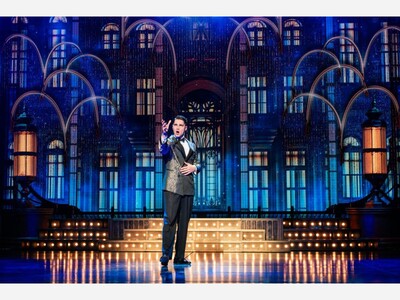
Austin Colby as Jay Gatsby in the North American tour of The Great Gatsby. Photo by Evan Zimmerman for MurphyMade.



By Anton Anderssen
The first time I saw The Great Gatsby, at New York’s Broadway Theatre in October 2024, I had just flown in from England. A two o’clock matinee had seemed perfectly civilized when I booked it. By the time the curtain went up, my body had formed its own opinion. I kept dozing off and waking to find that the party had gone on without me. When the national tour came to Detroit’s Fisher Theatre, I wanted to see what I’d missed, this time after a good night’s sleep.
By the afternoon of November 17, I was ready. My mobility scooter was another matter. The battery had refused to charge, and for a while I thought I might miss opening night. Then a twenty-dollar replacement charger did its job, and a small green light came on. I took it as a literary omen. By evening I was at the Fisher, where Jay Gatsby spends a fortune in pursuit of his green light and has far less to show for it.
I would have hated to miss this one. Marc Bruni’s touring production fills the Fisher with gold, gowns, and dancers, then makes a man who has lost his nerve in a room full of flowers the most interesting person onstage. Austin Colby and Senzel Ahmady make a splendid Gatsby and Daisy. I believed their pleasure in seeing each other again. I had more trouble believing that one of them had built a whole life around the prospect of that afternoon.
Paul Tate dePoo III’s gold geometric panels feel at home at the Fisher. His scenic and projection design can give Gatsby room to entertain half of Long Island and then make Nick Carraway’s cottage feel barely large enough for two people and the five years they have to account for. There’s also the pleasure of seeing a period automobile roll onto the stage. Gatsby would have expected nothing less.
Linda Cho’s Tony-winning costumes would reward a second visit all by themselves. I’d gladly watch “New Money” once for Dominique Kelley’s choreography and once for what happens to the clothes when the dancers turn. With Charlie Alterman conducting, the orchestra gives the number the buoyancy of a party only just getting started. Fitzgerald’s indictment of wealth has more bite when you understand the pleasure of being admitted to the room. Given the chance, I would have accepted Gatsby’s invitation, too.
Colby has the voice and presence to make an entrance in a production built on that scale. My favorite thing about his Gatsby is how readily he gives up the advantage. At Nick’s cottage he has provided enough flowers to remove any doubt about his financial circumstances and establish considerable doubt about his composure. He has prepared for everything money can arrange. Now Daisy is at the door, and he has to think of something to say.
Colby sings “For Her” beautifully, but the title gets at what has always puzzled me about Gatsby. When I think of Joan Rivers or Dolly Parton, I can understand the determination to rise above difficult circumstances and build a life on your own terms. Doing all that work for the chance that a woman you knew five years ago might leave her husband strikes me as a very long way to go for a very uncertain result.
Gatsby makes more sense to me when I remember that James Gatz had already invented Jay Gatsby before he met Daisy. He had begun putting a distance between himself and the poor farm boy he had been. Daisy grew up with the standing he was still trying to acquire. At the Plaza Hotel, she could tell him she loves him now, and he would still need her to say she never loved Tom. Her love in the present would seem a considerable thing to win. He wants the intervening years as well. He needs her to tell him that the life he imagined for himself was always within reach.
Ahmady is every bit Colby’s equal, and I liked Daisy best when she seemed to know things Gatsby had never thought to ask her. In Fitzgerald, Daisy hopes her daughter will grow up to be a beautiful little fool. Kait Kerrigan’s adaptation, with music by Jason Howland and lyrics by Nathan Tysen, gives Ahmady a whole song to show us why Daisy might wish that for her child. She lets “Beautiful Little Fool” soar while keeping something of Daisy to herself. You can hear why she might dream of leaving Tom and still understand what it would cost her to go.
I wish the musical had left as much mystery around Nick and Jordan. Joshua Grosso is a charming Nick Carraway, and I found myself wishing he were a little less good at it. I have a soft spot for Fitzgerald’s earnest young man who spends evenings studying securities at the Yale Club. As vice chair of Mensa Hawaiʻi, I know people who can explain an intricate subject with perfect confidence and then spend the rest of the evening wondering whether someone was flirting with them. There’s a little of The Big Bang Theory in that, and I mean it affectionately. Grosso’s Nick seems quite at home at the party. I missed the curious, slightly dorky Nick who goes along with people bolder than he is and then has to think through what he’s agreed to.
I’ve always assumed that Jordan Baker was a lesbian. Fitzgerald gives her the bearing of a young cadet, a cool wit, and an inner life that Nick can only guess at. Even when he draws her close, he sees something scornful in her smile. Leanne Robinson gives Jordan wit and poise. The musical presents her as more conventionally feminine and much more openly drawn to Nick. In “Better Hold Tight,” she proposes, and he accepts. There’s wit in having Jordan do the asking, and Robinson and Grosso make the romance easy to enjoy. I still missed the woman who could enjoy Nick’s company and leave him, and me, wondering what she wanted. I do know lesbians who married gay men. Someone has to know how to tastefully choose the living room drapes, and someone has to know how to weld the cracked joint on a steel patio chair.
By the end, the couple that interested me most was the Buchanans. Will Branner plays Tom with the ease of a man accustomed to being obeyed. Lila Coogan’s Myrtle can picture, in exquisite detail, the life she wants, and Tally Sessions gives George Wilson a gravity that grows more consequential as the evening goes on. Then Daisy, at the wheel of Gatsby’s car, accidentally kills Myrtle, Tom’s pregnant mistress. The turn I savored most was how easily Daisy got away with it. I’d spent much of the show wondering whether she would leave Tom. In the end, the marriage I’d been rooting for her to escape is the very thing she can retreat into.
My green light told me the scooter was charged. Gatsby looked at his and saw a place in Daisy’s world. He spent a fortune trying to get there. Gatsby was willing to take the blame. Tom was ready to leave town. Daisy had only to go with him.
Image: Austin Colby as Jay Gatsby in the North American tour of The Great Gatsby. Photo by Evan Zimmerman for MurphyMade.
Reviewed November 17, 2026, at Detroit’s Fisher Theatre. The engagement runs through November 29.
Contact the author AntonAnderssen at gmail.com

Patchy rain nearby, with a high of 78 and low of 70 degrees. Patchy rain nearby for the morning,